 Nothing fills the classroom with more excitement and cheer – and gives you instant celebrity status (the coolest teacher ever) faster than the declaration of Game Time!
While students see this is as a well deserved break from all their hard work, what they don’t suspect is that it’s actually a way to consolidate their learning, albeit outside the typically structured setting (but they don’t need to know that). Playing cards reinforces important math skills (number sense; number recognition, counting, adding, subtracting), social skills (taking turns, sharing, sportsmanship) and builds on children’s strategic thinking and planning. As a teacher, of course, observing my students play is the perfect opportunity to also assess their strengths and weaknesses in these areas and plan future lessons based on their needs.
So go ahead – roll up your sleeves, gather eager players, hand out the cards and let the games begin!
A few notes:
- For the purpose of the games listed below, an ace represents the number one.
- Unless otherwise specified, each game is played in a group of 3-4 students, but can be modified to include more or less players.
- If you want your students to keep score, have some paper and pencils handy.
- Remind students to shuffle the cards well before each game.
CARD GAMES FOR THE CLASSROOM
Give Me Ten
Place all the cards facing down in the centre of the table. Each player picks up 4 cards and holds them up, not revealing their cards to the other players. Four additional cards are drawn and placed in the middle as the ‘bank’ reserve. The first player tries to match one of their cards with one from the bank to add up to 10. For example, if a player holds a 6 and the bank has a 4, they collect the card and place it aside as a ten-point. They can also add up to 10 by picking up various other combinations (i.e., 6, 2, 2 or 5, 1, 4) and by using as many of their cards as possible in one turn. The aim is to make as many sets of 10 as possible. If/when the bank is ‘empty’ the current player must put down any random card from their hand and the next player continues. With each round, players continue to pick up 4 cards and aim sets of 10. A king can only pick up a king, a queen only a queen, a jack can pick up all the number cards. When no cards remain, the player with the most sets of 10 wins the game. As an alternative, instead of adding to 10, choose another number (i.e., 11, 12).
One Hundred
Each player picks up 4 cards from the deck and place them face up. Players rearrange their cards and try to create number pairs that add up to 100, or else as close as possible. For example, the cards 9, 1, 4, 5, can be arranged to create two larger numbers: 51 and 49. When added together 51 and 49 equal 100. When everyone’s ready, they should share their final numbers. Whoever is closest to 100 receives a point. Play for 10 rounds. The player with the most points at the end of the final round wins.
Memory Game
Spread the cards face down on a table in a random pattern or in a grid. Players take turns turning over two cards while all the players can see them. If they are not a matching pair, they turn them back over. The next player turns over two cards. If they are a matching pair, that player removes them from the table and keeps them, and then has another turn. When all cards have been removed from the table, each player counts up the number of cards they have collected. The player with the most matching cards wins the game. This is a great game to enhance memory and concentration skills.
Bluff
Divide all the cards equally among the players. Players may organize their cards without showing them to the others. The first player places a card face down in the centre of the table saying ace. The next player must place down a card higher up in value (i.e., number 2). The following player discards threes, and so on. Players announce their cards as they lay them. After kings have been played, aces start again. Players can discard up to four cards at a time. Players don’t have to play the cards they announce – they can be bluffing. After each turn, any player can challenge the last player (if they believe they are lying) by saying You’re bluffing! When this happens, the challenger can look at the discarded cards. If they match what the person who played them said, the challenger picks up all cards in the discard pile and adds them to his personal pile. If the cards are not what the person said they were, the player who discarded them must pick up the entire discard pile. The player to lay down his entire hand of cards first will win the game.
Higher Up
Divide all the cards equally among the players. Cards facing down, each player turns over a card from their ‘bank’ and puts it down in the centre. When all of the players had a chance to put down a card, the player with the highest ranking card takes them all and places them aside. With each round, players continue to place down cards from their ‘bank’, until no cards remain. The player with the most cards at the end wins the game. As an alternative, the player that can make the most sets of ten wins the game (i.e., 5, 2 and 3 is one set of 10; 9 and 1 is another, a king and a king is a ten, etc.)
Crazy Eights
Each player is dealt five cards. The rest of the deck goes facedown in a pile, with the top card turned up beside it. This is the discard pile. The player to the left of the dealer discards a card from his hand that matches either the number or suit of the top card in the discard pile. For example, if the card is a five of hearts, he could play any heart or any five. If he does not have a matching card, he continues picking up cards from the deck until he gets one that is playable. Eights are wild and can be put down on any suit. For example, an eight could be played to match a heart. The next player must match their card to the number or suit that the eight was meant to cover. Play continues with players matching the card at the top of the discard pile. The first player to use up all his cards wins. If the deck runs out before the game is over, the discard pile can be used.
To download a free copy of Card Games for the Classroom for your personal use in the classroom, click on the image below.

Happy playing,
Lora


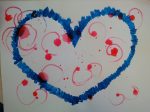
 Mother’s Day is fast approaching and we have surely begun preparing for it in the classroom. This year we are showing Mom (or the special mother-figure in our life) how much we love her with lots of kisses in a love-filled picture frame. We sure hope this becomes a craft Mom will treasure.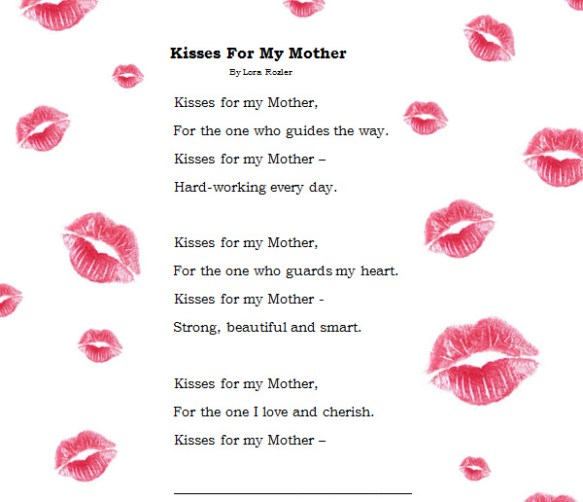
 1. Take a profile picture of each student blowing a kiss into the air, head slightly tilted upwards. 2. Ask students to enlist help from family members (other than their mom) and bring in a picture of their mom for the frame.


 Join me at Indigo Richmond Hill on Sunday, April 17 at 12 pm. I’ll be reading from my picture book WORDS and then hang around for some fun activities and book signing. Hope to see you there!
 Hello everyone and welcome back to Words on Art, where we invite artists and writers to collaborate and creatively blend brush strokes with words. We would like to thank Jessica for her successful writing submission, Sweet Oranges, chosen to complement Al Gord’s painting, titled A Changing Perspective. We would love to hear your feedback on this creative blend. Feel free to share your thoughts in the reply box below. Thank you Al and Jessica.


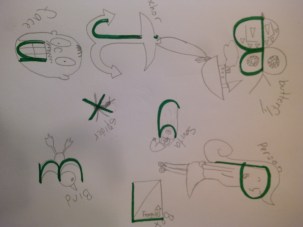
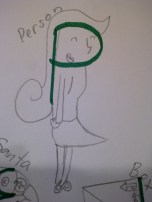
 Boredom Buster is a term my daughter recently coined for an activity I introduced her to while she was waiting for her brother to finish his lunch (I should mention that sledding was next on our agenda and so she was impatiently nudging our slow eater along). I drew a letter in her sketch pad and challenged her to turn it into a picture. Before long, her sketch pad was filled with dressed up letters. My son, who had been eagerly watching, asked to join in. With the promise of eating faster and multi-tasking efficiently, he set to the boredom buster as well (which by now was serving a different purpose entirely). Five minutes later, the lunch plate was empty but neither of them were in any rush to go sledding anymore (gotta love those moments).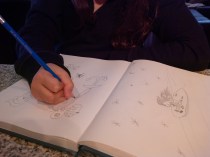
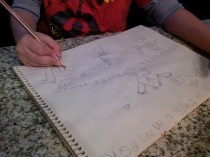
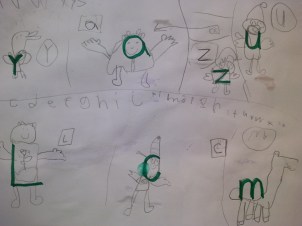
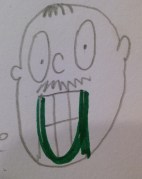
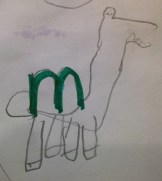


 The other day, I came home with a small box of groceries. As I emptied out the box, an idea struck. Knowing kids love to make crafts (especially out of boxes) I challenged my children to think of something useful they could make out of the box. I gave them one condition – they had to agree on what they would use the box for. Excited by the venture, they set on their way, thinking and planning. I overheard them talking about what they each wanted the box to be used for (yes, you guessed it – they were not on the same page). I continued eavesdropping, pretending to be busy in the kitchen, hoping they’d soon come to a consensus. Five minutes later the arguing began and so I stepped in. My goal was for them to present their idea together, but perhaps a little friendly competition wouldn’t hurt.
 Words on a Limb would like to wish you and your family a happy and healthy New Year! Here’s to a year filled with abundant blessings, the greatest of health and plentiful smiles and laughter. May 2016 bring joy to our hearts, comfort to our pockets, love to our homes and peace among all nations.



 in a couple of years, it will be time for me to start college. It took me a long time to adjust to being in high school so I worry that being on a college campus will simply be too overwhelming for me. As this article from Canine Journal on
  As this article on service dog tasks notes, my dog and other service dogs are actually trained to nudge a child on the autism spectrum when they give in to
  autism spectrum’s ability to wander. And while wandering isn’t an issue I’ve ever had to deal with, my dog will keep me safe in other ways. For example, he can be my eyes and ears in public situations that I might find overwhelming. When I do feel overwhelmed, it can be difficult for me to figure out what to do to get myself out of the situation. When I’m in reaction mode, I don’t always notice everything in the environment around me. My dog will help calm me down and help lead me through these situations.
 but one of the most important roles he’ll play is as my companion. Who wouldn’t want to spend their time with a friend who can, as this article from Mental Health Dogs notes,
 Words On A Limb