Nurturing a Growth Mindset in the Classroom
Hello everyone – happy Monday! I wanted to share my latest poem with you.
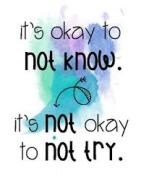
Yes, I Can! was inspired by a lot of self-defeating comments I’ve come to hear over the last 18 years teaching. Truthfully, if I had a nickel every time I heard a student say I can’t do it, I’d be off on a yacht somewhere right now (nah, maybe not – I get sea sick). Joking aside, the reality is that none of us are perfect. None of us can do everything. And sometimes, no matter how hard we try, we still don’t master various things – and that’s okay, at least we tried.
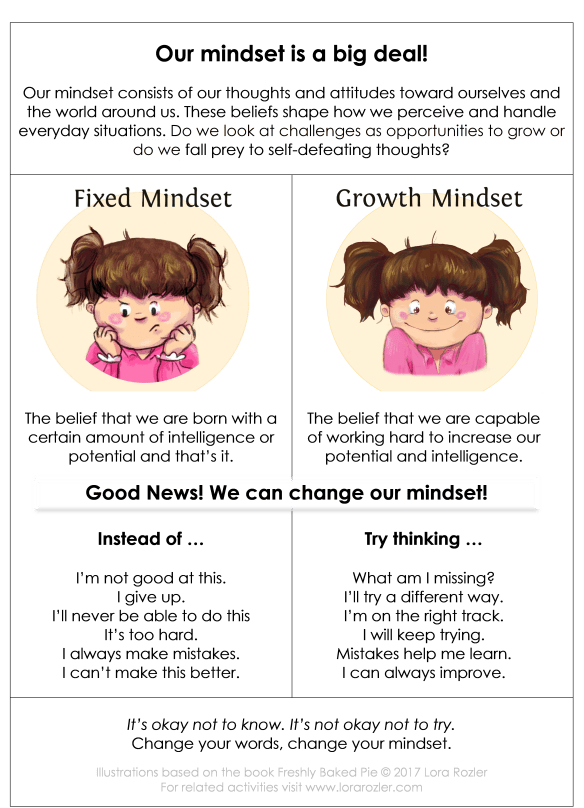
It’s when students give up before they even try that it’s NOT OKAY. That’s the point I’ve been trying to make with my students last week. Yes, some things are hard. Some tasks will challenge us. But the attitude we have toward challenges is what determines the outcome. It is this mindset, over time, that will shape and condition our thoughts and beliefs about ourselves. Our mindset consists of our thoughts and attitudes toward ourselves and the world around us. These beliefs shape how we perceive and handle everyday situations. Do we look at challenges as opportunities to grow or do we fall prey to self-defeating thoughts?

Yes, I Can! is a poem I wrote that celebrates what children can do, as well as embraces that which they cannot, yet, do. Teaching children to have a “Growth Mindset” is crucial in helping them become better learners. After all, in order to succeed at anything, we must persist and push ourselves forward, despite the challenges. Positive self-talk is what helps children persevere and not give up. Yes, I Can! encourages children to adopt positive self-talk. Instead of focusing on ‘I can’t do it!’, it re-frames their thinking, ‘I can’t do it, yet!’
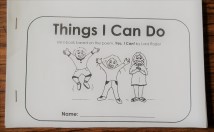
Along with the poem, I created a follow-up worksheet (rehearsing high-frequency word can) and a mini-book that is co-authored with me (my students were thrilled with the idea). It invites students to fill in a missing high-frequency word, as well as add a skill or task they can complete successfully, as well another skill they aspire to learn, reminding them that their mindset is the only thing in the way.
Yes, I Can! by Lora Rozler is licensed under a Creative Commons Attribution-NonCommercial-NoDerivatives 4.0 International License.
Based on work found at www.lorarozler.com
In all the excitement to teach children that our mindset is not a fixed state, I created a visual anchor for the classroom. Feel free to download a copy for your personal use by clicking on the image below.
To download a copy of the poem, Yes, I Can! along with the follow-up activities, click on the image below. 
Wishing you a fabulous week ahead!
Lora



 A very interesting math lesson stemmed from a story I read to
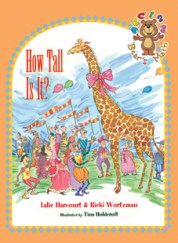 my students about a king who got a giraffe as a birthday gift. The king challenged his townspeople, offering a reward to the first person who would be able to tell him how tall his giraffe was. The people set off to measure the giraffe in whichever way they could – none of the attempts were successful. Every failed try served as a great lesson about measurement do’s and don’t’s.
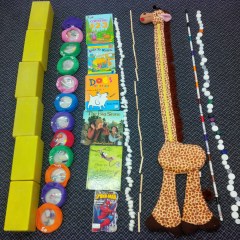 After extracting important math concepts from this adventurous story, I introduced students to a giraffe of my own (my children’s old plush growth chart). I posed the same question to an eager-looking bunch (there was no gold incentive on my end though). With just enough direction, I let students explore solutions to this problem during Learning Centres time. Students showed remarkable interest in this challenge and began gathering all kinds of objects to use as measurement tools.
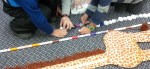 Before long, the carpet was filled with various
 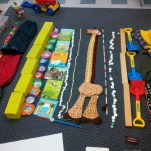 objects: building blocks, popsicle sticks, snow pants, jackets, bottle caps, books, markers, etc. Students were so excited, they even suggested using me as a measuring tool. How could I say no to that? After a few chuckles and excited cheers, we sat
 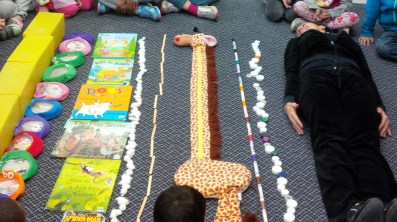 down to reflect on our findings, which ultimately led to another great inquiry question? Why did we need so many cotton balls yet such few blocks? How does the size of the measuring tool affect the measurement?








 Hello everyone. I hope you had a restful March break and are excited about the week ahead. I’d like to share a poem I wrote a little while back titled,

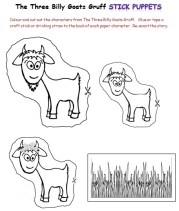 One of my students favourite follow-up activities was to re-enact the poem using stick puppets. It is a wonderful way for them to practise retelling the story and have fun while doing so. Some benefits of using stick puppets to teach literacy include strengthening oral vocabulary, acting in role, building comprehension, retelling a story in sequence, and recalling details.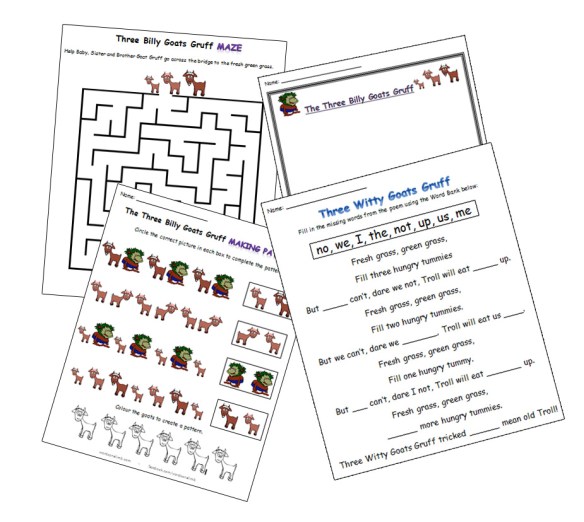


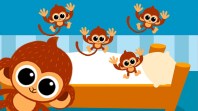
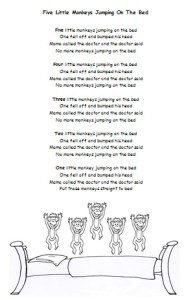 As I go through the story again (generally over the span of a few days), I take a moment after each verse to introduce a math fact or draw a composition of the monkeys in relation to the bed (i.e., 5 monkeys on the bed and 0 on the ground; 5 + 0 = 5). By the end of the story, we cover all the combinations of five. While we review the math facts, I draw their attention to the pattern that emerges (i.e., when the number of monkeys on the bed decreases the number of monkeys on the ground increases). For the rest of the week, I invite 5 different students each day to come up and re-enact the poem while we sing to it. We continue to review the math facts as we go along.
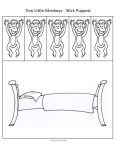 As an extension, and one that students really enjoy, I have students re-enact the story/song using stick puppets. They begin by colouring and cutting out a template of the bed and the 5 monkeys. Then they glue a popsicle stick to the back of each monkey and take turns re-enacting the story/song to a partner. By the end of the week, the stick puppets get sent home with a letter to parents.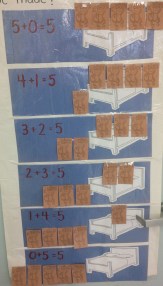
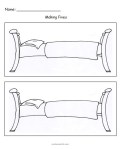 A great way to gage students’ understanding of the concept and evaluate their learning is to have them repeat this activity with bingo dabbers (one colour representing the monkeys on the bed, and another representing the ones on the ground). Each student gets 6 bed templates and uses two colour dabbers to show the various combinations the monkeys could be arranged (i.e., 3 dabs on the bed, 2 on the ground).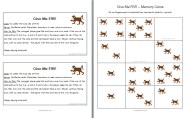
 Here is a card game I made to help students practice their facts to five and sharpen their memory skills while they’re at it. After introducing it as a whole class activity, I left it at the math station for students to play with during Centre time. I will be sending home a template of the game for families to assemble and enjoy during the March break as well.

 Have a fabulous March break!
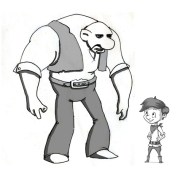 Happy Monday everyone. I’d like to share a poem I wrote a couple of years ago and plan to share with my students this week, as we begin exploring the concept of measurement. The Giant and I is a charming poem about a little boy who outsmarts a fearsome giant. It opens up a great discussion about the various ways the characters could be described (big, small, tall, short, heavy, light, wide, narrow, etc.) hence setting the stage for building the appropriate vocabulary for the unit. A follow-up activity is included, integrating concepts about size and shapes.
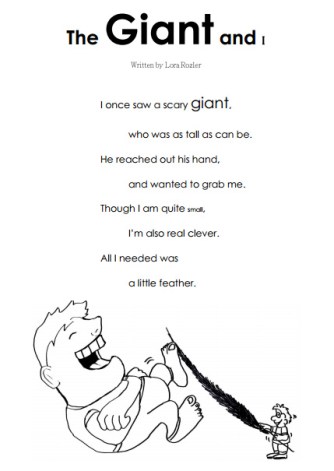 Click on the image of the giant to download a copy of the poem and worksheet for your personal use in the classroom.


 He piggy-backs me to my room



 Words On A Limb