Happy Family Day Everyone!
 If you are an author or avid reader, you are definitely familiar with Goodreads. If you are not, you are in for a treat, you should go ahead and visit goodreads.com. If you have visited our website often, you’ll know that we have often pointed you in that direction for further information. One of the joys of Goodreads is that we often meet terrific authors with special stories to tell.
One of those terrific authors is A.S. Chung. She reached out to us from her home in Melbourne Australia, to discuss doing a feature with her. After doing a little research, we realized that Amy (A.S.) was not only an author but she also conceived Pigeonhole Books as an avenue to create books that both empower and enrich families – especially non-traditional homes with blended, divorced, multiracial and same-sex families.
In general, mass market literature tends to shy away from books that do not depict mainstream family circumstances, understandably so if the goal of selling books is to bring as many people under the tent as possible. However, as Bob Dylan wrote, the times they are a changin’. Now, we see established authors delve into the non-traditional with titles such as Patricia Polacco’s In our Mother’s House and Leslea Newman’s Mommy, Mama and Me and of course I Wished For You: An Adoption Story by Marianne Richmond.
This coming February 16th is Family Day in Canada. We are so encouraged that Amy does a great job gently introducing young readers to families that don’t necessarily look like everyone else’s, but are still overflowing with love. The stories are told with great energy and from a child’s perspective.
Author Teresa Villegas did a piece for us a while back, sharing with us neat ideas on how to talk to kids about being born into an egg or sperm donor family. Today, similarly, we feel inspired to share Amy’s story with you. Enjoy!
About writing …
When did you first realize you wanted to become a writer?
Writing has always played a significant role in my life but it was always just something I did, be it for education, work or fun. I enjoy blogging and I have always loved putting pen to paper.
However, I first realized I wanted to become a bona fide writer when it became an outlet to express how I felt while going through my divorce. It was an excellent way to release all my feelings and thoughts and I was amazed how I felt afterwards. I haven’t been able to stop since then and I now write children’s picture books for kids from diverse family backgrounds.
What book(s) has most influenced your writing?
I read widely as a child. I read all the classics every child should and in most cases, the resounding style I enjoyed the most was anything which stretched the imagination. The likes of Roald Dahl and C.S. Lewis resonate with me, even until today. While my stories are less fictional and far from fantasy, these authors provided me with the courage to push past the boundaries and write what I wanted to, simply because I could.
When and where do you prefer to write?
Anytime is a good time! Ideas always seem to pop into my head at the most inopportune times. I’m often in situations where the concept and words flow faster than I can write because sometimes they come to me while I’m standing in a middle of an aisle in the supermarket! Most times, however, I do love to write in the comfort of my own home, in front of the computer with a cup of tea, as I lounge in my pyjamas.
What was your biggest challenge in writing your book?
Reducing the length of the manuscript. I could have gone on forever!
While going through my divorce, with a 4-year-old in tow, I was constantly worried about my daughter’s state of mind. There were plenty of resources at my disposal to deal with this life challenge, however, I felt that I needed to find an alternative way to communicate with her, to tell her that life is beautiful and that everything will be ok. I felt that telling and reassuring her was simply not adequate. So, I decided I would further highlight the good in what we currently have through loving words and beautiful illustrations. The message of the book is to hone in on the positives because at the end of the day, she has no choice. So let’s not wallow on the challenges and difficulties.
I also wanted a gentle resource for close family and friends. Divorce also affects the people around us and changes social dynamics. It makes for a difficult conversation to have with children when they’re not in this position themselves.
Based on this premise, my first attempt was a jumble of feelings on paper. There was no structure or body to the story. I simply wanted to write. When I finally finished everything I wanted to say, I had to peel it back and segment my thoughts. The result was an additional three manuscripts in the series that are currently being worked on.
What advice do you have for other writers?
Write all the time! Write about anything and have a great time doing it.
Believe in your words and your message. Don’t sway too far away from your initial goal as you may not like the finished product. Stay true to yourself.
About you …
What do you like to do when you are not writing (other than reading, of course)?
My most favorite thing in the world to do is spending time with my daughter and partner and we’re extremely active and social. Travel and photography take on a natural second and third place.
Travel continues to educate my heart and soul. I love discovering things about places I had visited before that I had never noticed in the first instance. Age, wisdom and maturity changes one’s perspective. I also love travelling with my new partner. He sees things I otherwise wouldn’t have and travelling with a child is even more exhilarating. Looking at the world through their eyes is always filled with wonder.
The camera (next to the laptop!) is my one prized materialistic possession. I love creating stories through pictures. My subjects are always people and I love being able to capture precious moments, when it was least expected.
Do you have any unique talents besides writing?
For a writer, I lead an extremely normal, left brain life. I’m afraid I don’t have any other special talents that would be deemed extraordinary.
What can we expect from you in the future?
A Brand New Day is but the first of many books in the divorce series to be published. However, I am currently working on the first book of the Pocketful of Pride series, entitled A Wishful Wedding, which delves into stories about same-sex families.
Quick Hits …
Is there an author that you would really like to meet?
I would love to have met David Eddings, an American fantasy writer. He was my “first love” and I was so engrossed and enthralled in his five book series The Belgariad as it introduced me into a wonderful world of fantasy. Much like J.R.R. Tolkien, he created an entire world, generations of characters and a language of its own. I have read all his subsequent books and feel like I have grown up with this fictional royal family! I wished I could have thanked him for immersing me into the kind of reading where I locked myself away for days and only left the room because I was hungry.
What book are you currently reading (eBook or paper)?
The Shipping News by Annie Proulx and Adultery by Paulo Coehlo. Adultery was released while I was reading Annie Proulx and I am an avid fan of Paulo Coehlo. I turned to Paulo Coelho’s spiritual words to get me through the difficult phase of divorce and in many ways allowed the slow minutes become beautiful days.
Who designed your latest book cover?
The most amazing illustrator I know, Paula Bossio. She is so incredibly talented and she has a remarkable knack of translating my words into art.
What is your favourite quote?
“Your children need your presence more than your presents.” Jesse Jackson
Visit with Amy:



 A Brand New Day – A Banana Split Story
by A.S. Chung, Paula Bossio (Illustrator)
Pigeonhole Books
Amazon | Chapters
Mondays and Tuesdays are fun, going on cooking adventures with Dad. We look forward to Wednesdays and Thursday too when we get to be a green thumb with Mum. Don’t forget the holidays! Spring breaks with Mum and hot summer camping with Dad. Each day is a truly special day!
A Banana Split Story is a series within the Pigeonhole Books collection that features stories about children from separated and divorced families.
Amy on Facebook:
Amy on Twitter:
 When you take a moment to get to know Amy through her books, publishing, blog, interviews and social media, you’ll discover a woman who has found a way to make a difference in people’s lives, one shared story at a time. She encompasses the true spirit of Family Day – a chance to celebrate everyone who feels their family around them, no matter what it might look like.
We congratulate Amy on her success and wish her continued good fortune in her bright future. Great to meet you Amy!
Words on a Limb would like to wish everyone a happy, warm, love-filled Family Day.

Lora

 One of my favourite ways to teach combinations of five begins with the story, Five Little Monkeys Jumping On The Bed (bear in mind, I teach Kindergarten but this could easily be adapted to other grades as well). After reading the story, initially exploring rhymes, patterns, and chants, I like to use it as a tool for teaching math facts to five.
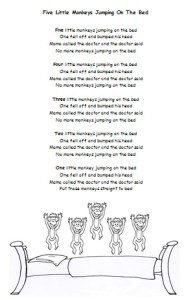 As I go through the story again (generally over the span of a few days), I take a moment after each verse to introduce a math fact or draw a composition of the monkeys in relation to the bed (i.e., 5 monkeys on the bed and 0 on the ground; 5 + 0 = 5). By the end of the story, we cover all the combinations of five. While we review the math facts, I draw their attention to the pattern that emerges (i.e., when the number of monkeys on the bed decreases the number of monkeys on the ground increases). For the rest of the week, I invite 5 different students each day to come up and re-enact the poem while we sing to it. We continue to review the math facts as we go along.
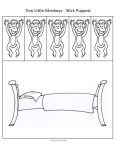 As an extension, and one that students really enjoy, I have students re-enact the story/song using stick puppets. They begin by colouring and cutting out a template of the bed and the 5 monkeys. Then they glue a popsicle stick to the back of each monkey and take turns re-enacting the story/song to a partner. By the end of the week, the stick puppets get sent home with a letter to parents.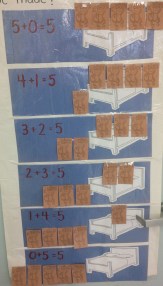
 A great way to gage students’ understanding of the concept and evaluate their learning is to have them repeat this activity with bingo dabbers (one colour representing the monkeys on the bed, and another representing the ones on the ground). Each student gets 6 bed templates and uses two colour dabbers to show the various combinations the monkeys could be arranged (i.e., 3 dabs on the bed, 2 on the ground).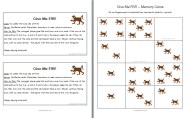
 Here is a card game I made to help students practice their facts to five and sharpen their memory skills while they’re at it. After introducing it as a whole class activity, I left it at the math station for students to play with during Centre time. I will be sending home a template of the game for families to assemble and enjoy during the March break as well.

 Have a fabulous March break!
 A woman is the embodiment of tenderness, strength, love, devotion and wisdom. On this International Women’s Day, Words on a Limb would like to extend our appreciation and recognize women across the globe for being the pillars the world stands on. For without love, nothing else matters.



 Another reason I love multi-race marriages is that they are creating new ‘breeds’ of children. We are now able to loosely and humourously identify them as Filatinos, Blacknese, Chicanese, Chindian, Korgentinian or even Blaxican! From blue-eyed kids with afros to freckled brown skin with natural blonde hair, these children no longer fit in distinctive racial silos. I look at these families and I see nothing but beauty and a whole new world ahead of us.
 Multi-race children inherit multiple ethnic backgrounds and by understanding the heritage of both their parents, they usually have a broader sense of the world. It allows them to be more empathetic in different scenarios instead of just having the one view-point. They become naturally open to understanding that different people make different decision based on diverse motivations. Possessing more than one language also contributes to children being more open-minded and worldly. The subtle etymology of their language brings about insights into their ethnicity.
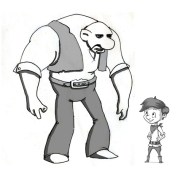 Happy Monday everyone. I’d like to share a poem I wrote a couple of years ago and plan to share with my students this week, as we begin exploring the concept of measurement. The Giant and I is a charming poem about a little boy who outsmarts a fearsome giant. It opens up a great discussion about the various ways the characters could be described (big, small, tall, short, heavy, light, wide, narrow, etc.) hence setting the stage for building the appropriate vocabulary for the unit. A follow-up activity is included, integrating concepts about size and shapes.
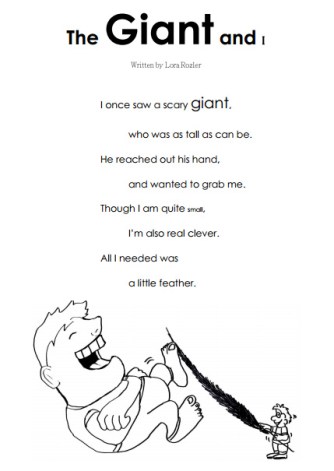 Click on the image of the giant to download a copy of the poem and worksheet for your personal use in the classroom.


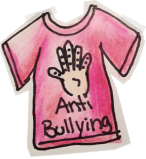 Bullying is a major problem in our schools, workplaces, homes, and over the Internet. During the month of February, many organizations across Canada will work to raise awareness on this issue and give us the tools needed to stand up against bullying and step in when we see it happening. February 25th is


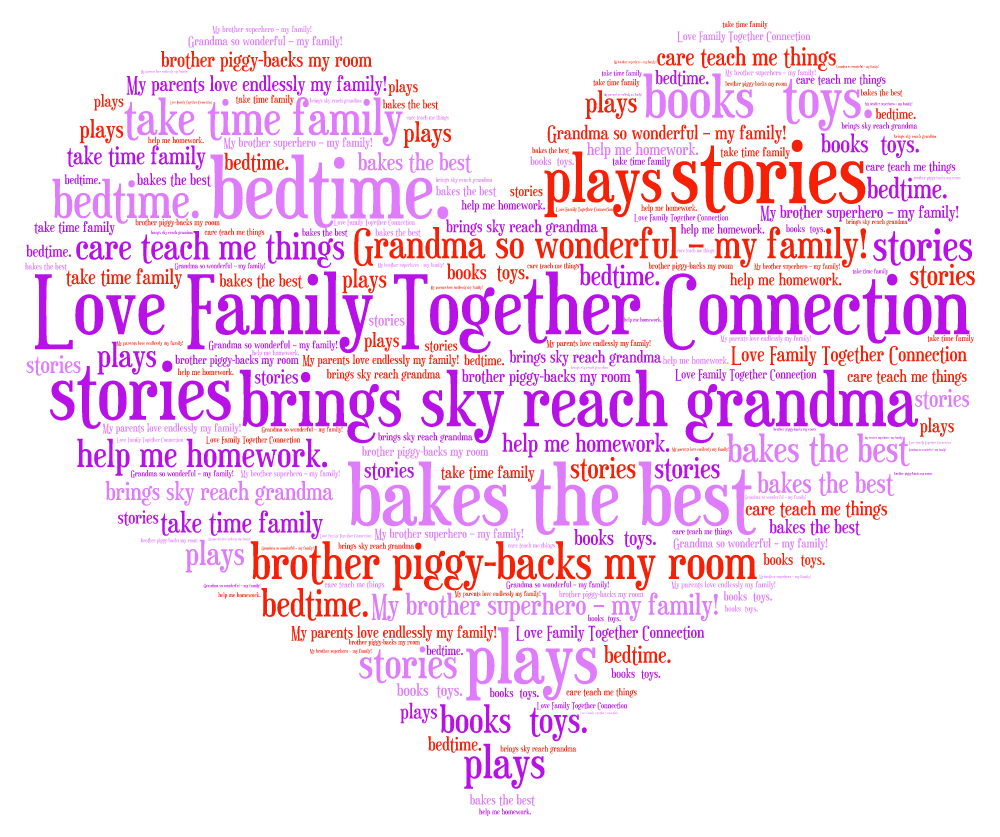

 He piggy-backs me to my room














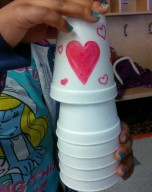
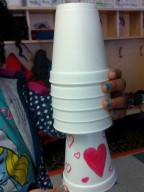 Upon signaling, the first player will begin stacking the cups, from top to bottom. The object of the game is to keep moving the cups from top to bottom until the ‘heart’ cup appears on top again, at which point they pass the stack to the next player and proceed to sit down at the back of the line. The first team to have all their players complete the task, wins the heart race!

 Distribute the hearts, one per child. Turn the music on and have students dance around the room . When the music stops, players need to stay in their spot and find a nearby match for their heart. They can stretch or bend to reach their matching heart but cannot move from their spot. Play the music again and continue.
 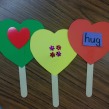 As a variation, or to add more of a challenge to the game, you can also write sight words (or Valentine theme words) and add images to the hearts. This way, not only can colours make a match, but words and pictures as well (either both or else one or the other).





 One look out the window on most winter days and your first instinct is to crawl right back into bed and curl up like a ball. But as cozy as that sounds, its not always an option.
 Peek-a-Boo, Why Don’t I See You – Animals in Winter, is a poem I wrote to help children understand how various animals cope during the winter. It introduces the concepts of hibernation, migration and adaptation.
 A fun and memorable way to acquaint students with the vocabulary is to form associations with them. (If you enjoy acting every now and then, this is a good time to show off those skills). I began by telling my students that I have a team of ‘scientists’ that will be working with us. I told them that my name was Bernate and asked them to wave and say hi to me, (hence hi-Bernate). Then I pretended to fall asleep (hibernating teacher). They seemed perplexed at first, but smiled when they understood what I was doing. Next, I introduced my pretend assistant named Grate (an invisible bird sitting on my hand) and gestured that he is only mine, (hence my-Grate). Then I pretended to catch him as he attempted to fly away (migrating assistant). Finally, I added our last participant to the mix – a very furry fox named Apt, (add-apt). There I had it, the terminology (and basic meaning) that students would need for the unit was now easily accessible with simple gestures as cues. (I can’t help but smile when I see my students mimicking the gestures I associated with the terms).

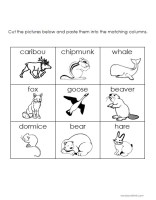
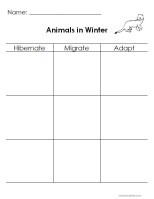 enjoyed reading many fiction and non-fiction books about Winter Animals, we have equally enjoyed filling a class chart on animals that hibernate, migrate and adapt. Though our list continues to grow each day, I selected various animals to be used in a follow-up sorting activity (sample here).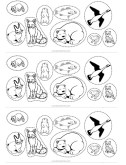
 Winter Wonderland
 Sleepy Bear Students use
 Words On A Limb