Words on a Limb Interviews Eric Litwin

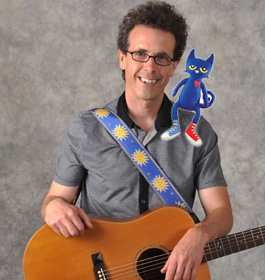
EricWe were ever so fortunate to spend a moment with the entertaining storyteller, musician, teacher and prolific author of the first four Pete the Cat picturebooks, Eric Litwin … Mr. Eric. He is also the author of the new musical series The Nuts.

He has spent the better part of his career championing literacy through music and movement, particularly impacting new and emerging readers. Eric has travelled across the US, Canada and abroad spreading the message of building creative communities where children feel confident tackling their first reading experience, and having a fun time along the way.

He spoke to us from his home in Atlanta, where he is busy dreaming up the further adventures of the Nut Family. Here is his story:


Where did you grow up? What were you like as a kid? What still holds true for you?
I grew up in Dobbs Ferry on the Hudson, a small town in the Hudson River Valley. It’s very beautiful there. As a kid I would say I was creative and quiet. I loved to read.

This is an interesting question, I give about 300 performances every year, where I entertain in front of a group, it’s hard to claim that I’m introverted and shy, but I will say that it’s been a long time since I’ve felt shy.

You have been a teacher. What were your influences encouraging you towards writing?
Wonderful question! I was a special needs teacher. I have a masters degree in both education and administration. My main interest in education was to get my students engaged and interested in reading, and feel empowered about reading. I was also a musician at night, focusing on getting my audience involved with a lot of folk type of music with interactivity. So I started using music and movement along with interactive techniques. My influences were folk tales and songs – the whole American oral tradition of music and stories.

Tell us the story about the first turning point of your career?
I taught for 3 years – I found my favourite part of teaching was creating the content and writing the story. I realized this was where my greatest gift was, so I left the classroom to create content and performances. I became a very popular performer, doing 200-300 performances every year for almost 10 years. I would perform in schools, libraries – during assemblies. Believe it or not, it was during these performances that I started to develop a writing style, which I now call interactive literacy, because I don’t have a better name for it. It basically means stories told with sing-alongs and move-alongs. There’s call-response and repetition. These techniques engage the audience and they engage the reader. It not only makes a great performance piece, but it also makes it a great early reader. That was the key to the first four Pete the Cat books.

So during those ten years I guess I did what Malcolm Gladwell calls putting in your 10,000 hours. I wrote the story of a little girl and her white shoes. It was the best story I’d ever written, I knew it was special. It was a story that would work with different characters so I would swap her out for a cool cat or cool dog. Some time after, I saw Pete the Cat at an art festival, he was a folk art character created by illustrator James Dean. I felt that this cat and the story of the girl with her white shoes were a good fit. I had a vision to blend early literacy, folk art and music together.

Continue reading

My Spiritual Journey

remToday is the day.

There have been many steps in my journey and now I feel I am ready to embrace a lifelong and forever commitment to Judaism. It is extra meaningful to me that this moment has arrived just a few weeks before Rosh Hashana. I hope and pray this will be a sweet New Year for me as well.

As part of my requirements for appearing before the Beit Din, I was asked to write a spiritual autobiography. I realized that this is actually very difficult, to put my experiences of changing my faith into words.

Anyway I looked back on the days and events, and tried to reflect on the spiritual side of my life. I was born and raised in Manila in the Philippines to a religious Catholic family. My 2 siblings and I were raised in a G-d fearing home with high moral standards by loving parents.

My parents sent me to Catholic schools, known for for their high quality academic excellence. After high school I attended university and in 2002 I graduated with a degree in Physiotherapy.

After university I felt a desire to leave home for “greener pastures” and to broaden my horizons.  But to do this I would have to leave my family and friends behind which I knew wouldn’t be easy. However the opportunity presented itself and in 2004 I immigrated to Canada; in 2011 I became a Canadian citizen.

In my early years in Canada I spent the greater part of my working time with Jewish families and sometimes went with them to the synagogue. I ate Matzah at the Passover Seder and lit candles with them and learned how to keep the laws of Kashrut in their homes. I feel I adapted quickly to their way of life. I heard more about the Holocaust – how 6 million Jews perished, innocent souls, murdered by Hitler, so heartbreaking to even think about.  I made close relationships in the Jewish community who became almost like my family and I thought the Jewish things they did were cool. I wanted to be like everyone else.

Continue reading

Talking About Difficult Topics With Children

by Teresa Villegas co-author and illustrator of children’s book “How We Became a Family”

Talking with children about difficult topics (such as sex, birth, death, war, politics, etc.) doesn’t have to be so difficult, if you have already established an open style of communication with your child. What exactly is an “open style of communication” and how to achieve this?

Well, it turns out that it’s basically the same kind of communication style that you would have with anyone; adult or child, relative or friend. And it’s founded on a handful of common courtesies: listening, respect, empathy and love.

Open positive communication with children means paying attention by listening to them without interruption, respecting the child’s thoughts and feelings, and connecting with them by empathizing with their opinions and views. Love is what binds this all together in how we express ourselves to children and watching the tone of our voice when we speak can either cause the conversation to open or to close.

Listening and respecting others are pretty much self-evident, and is only a matter of allowing yourself to put them into action. Children learn “active listening skills” from their grade school teachers and keep us reminded of this elementary skill we adults and parents now call “being present.” When we talk to other adults, we can openly challenge that which we do not agree with. However, this approach can stifle a child’s willingness to speak openly. Since their desire is to please us, we need to make sure we do not curtail their emoting by our statements. We need to acknowledge their point of view, and then we can proceed to explain why we believe our point of view.

Empathy can be defined as the ability to feel or imagine another person’s emotional experience. An innate quality we are born with that allows us to make personal and social connections with others and to further the line of our species. Children are closer to their feelings than most adults, and that’s a good thing! We can all respect and understand the feelings of anger, frustration, uncertainty, loss, grief, and joy.

Love and the tone of voice when we are communicating, are not always one and the same. Our tone of voice conveys more to our children than any words. Statements can spill out of our mouths without our realizing how it can sound to a child. Tone of voice and listening were the two skills I immediately noticed and admired when I first met my husband before I knew what he did as a profession. As we became friends, then newlyweds and then as new parents, his listening-skills-training as a psychologist and physician, fostered an open communication style within our relationship and with our children. But you don’t need to be a doctor or married to one to put these skills into use. When attention is given to listening and noticing our projected tone of voice with our responses, we learn a lot about ourselves and how we come across to others with whom we are communicating, especially our children. When we convey patience and serenity in our conversation, it opens up discussion.

When our children ask us questions and/or interrupt us, our tone of voice may often be saying “what now?”or “can’t this wait?” or “I really don’t know how to answer that” combined with our curt words answering “yes, sure, maybe, no, not now, later, ok?” When I catch myself doing this dance of communication avoidance, especially with tough questions or topics I’d rather put off for an eternal “another time”, I’m reminded of two thoughts I’d like to share with you. I don’t remember which of the gazillion parenting books or articles where I read these, so I apologize for my failure of referencing the particular sources. Their emphasis on focusing on the moment and their wisdom reached out and grabbed my attention and my heart. They have helped me and have stayed with me to this day. I hope they do the same for you.

• Ask yourself “when your child walks into your room, does your face light up? Is your child aware of how important they are to you and how much you value their presence?”

• When you find yourself talking with another person or child, ask yourself
“Is love available here? Can I make space for love to enter into this conversation?”

When I can stop (this is a conscious ongoing process for me), and if I can remind myself of these two concepts above, it helps me to come to center with every tough question or conversation our children bring up and it becomes easier to communicate in an open, honest and authentic way.

One of the toughest topics we are very familiar with and have been talking a lot about
since our children were born, has to do with how many different ways that families are made. In today’s society, along with the advocacy of open communication and open information on the internet we know that there are many different kinds of families. For some families like ours, it takes more than the traditional concept of family. Sometimes, it takes science and the help of others.

Talking about infertility and how you built your family via IVF and an egg donor or a sperm donor is more accepted now than it was 10 years ago. Awareness is growing. However, it’s still a topic that can be hard to broach with your family, friends, and your children. It is our hope that creating a family with donor assistance will become as common to talk about and accepted in our society as adoption has become.

Within the U.S., more than 10% of all couples suffer from infertility and one in eight couples need medical help to create their families. Fortunately, there are many options with the help of medical science and a donor, but many parents are at a loss to explain this process to their child.

With so few role models to follow, it’s hard to know how to approach this conversation with young children. The following tips will help parents feel comfortable and begin telling their donor-conceived child, how they became a family through science and the help of others.

For more in-depth information please visit our website HowWeBecameaFamily.com.

How To Talk With Your Child About Their Donor Origins

1. Let Go of Your Genetic Dream Family. Acknowledging that you wont be raising a child with yours and your partners’ genes combined is heartbreaking for most couples, and it’s normal to experience this grief – if you allowed it. After experiencing years of infertility, and in your drive to become pregnant, you may have skimmed over or delayed this first crucial step. If you have not begun this subtle, yet necessary step, it may be part of what’s holding you back from feeling ready to talk about it.

2. Define Your Beliefs About Family. Defining what family means to you will strengthen your ability to communicate about how you chose to build your family, should you encounter any negativity about your decisions. Perhaps what you’ve discovered is that love, trust, relationships and support are the foundations that make up a family – not genetics. Understanding how you feel about your choices will make it easier for you to explain them to your child.

3. Affirm The Donor. Regardless of whether you chose to have an open or anonymous relationship with your donor, it’s a good idea to talk with your child about the significance of the donor’s role with appreciation and respect. Children intuitively tune in to your feelings about the donor. Because the donor will forever remain in your awareness, and because how you think and feel about the donor will affect your child, embrace them and celebrate them wholly.

4. Tell Your Child Early. Generally, it is not conception that you want to communicate about as much as the unique path by which your child has entered into your family. Therefore, begin to practice talking about the presence of the other people in that child’s life to whom they may be genetically related, normalize it as it is – a basic fact about their life. “Before you were born, we needed help from a very kind person, for us to make you.”

5. Embrace Your Child’s Curiosity. As your child learns about their donor origins, they may be curious about the donor and wonder and ask questions such as “What are they like?” What do they look like?” As your child grows, they may ask more mature questions such as “Why did they donate?” “Do they have children too?” Research shows that donor conceived people are inquisitive about their donor origins even when they experience positive parent-child relationships. Curiosity will continue and evolve and they will look to you to help them understand it all.

Using a children’s book to introduce the conversation with your child about their donor conceived beginnings is an easy way to start. The How We Became a Family children’s book series is a welcome relief for parents of children born through IVF with donor conception.  There are four versions available depending on your family’s needs. Two versions are for families whose children were conceived with an egg donor, resulting in either a single child, or twins. Two other versions are for families whose children were conceived with a sperm donor, resulting in either a single child, or twins. The books are beautifully designed, with highly-nuanced illustrations with remarkable combinations of depth and whimsy to be read with children ages 2-10. Introduce the conversation with ease by simply reading together. Published by Heart and Mind Press it is now available. Each book is a high quality hardcover children’s picture book with a matte varnish cover, full color, 32 pages of heavyweight uncoated interior pages, 8″x 8″ for parents to read with their child. For more details on how to purchase a book, for your family or as a thoughtful gift, visit HowWeBecameaFamily.com.

email-icon-png-blue-9vzn7mz2 Facebook Pinterest 


I was able to connect with Teresa and Bernard through our site’s various communications with authors and illustrators. After reading their book, I felt their story shone a light on a topic that most of us do not typically have a chance to discover, unless of course our lives are touched by this miracle. As a bonus, we also learned some healthy tips on relating to the most important loved ones in our lives.

I want to extend a warm thank you to Teresa for taking a moment to enlighten us today. We wish them love, happiness and continued success with their blessed home and their endeavor to help educate. I encourage you to visit their website and “fill your tool box”.

Lora

Making Back-to-School a Success

Making Back-to-School a Success
by Stacy Cline


In my blog in July, I noted that old refrain “…no more pencils, no more books, no more teachers…”
Guess what? We’re baaaa-aack!

I have heard the following phrase often in the last few weeks: “School is a dirty word in our house.” No one wants to let go of summer. But school is around the corner and it’s time to think about it (even if you don’t want to say it, being a dirty word, apparently) so that we’re well prepared to return to you-know-what.

Summer is often a time of lazy days, with a side of ice cream. School is a time of routine. It’s critical to return to those old routines, so that the first week of September isn’t such a shock.

Bedtime routines should be back in place before school begins, if you’ve been lax over the summer. Morning routines should also be revisited. If they have been sauntering into the kitchen to eat breakfast in PJs, then get back into the old habit of getting dressed first, if that had been procedure. Write a checklist for the first week to remind you of all that needs to be done to get out the door. I will, because I know I might not remember to pack their water bottles or something like that. Two summer months is sufficient time to forget.

If nightly read alouds or your child’s independent reading time fell by the wayside over the summer because of late bedtimes, restore that good habit now. A new book of their choice is a great back-to-school gift. A reluctant reader might like a graphic novel or even a comic book.

Ensure there is ample time to eat a nutritious breakfast every morning. This is crucial, and one of my greatest worries as a teacher. Children who arrive at school nourished are energized and perform far better. Aside from nutritional concerns, hungry kids often have difficulty focussing.

Practice new skills. Maybe they are learning to tie shoelaces, dress themselves or pack their own lunch (preferably the night before). Homework policies should be planned and discussed. Where will homework be completed, such that it is a quiet space with little distraction? What time of day? Before or after TV? Prepare for effective and consistent study habits now, and this will help avoid conflicts later.

Organize their supplies. Assuming that the zipper on the pencil case isn’t busted, there aren’t holes in the knapsack and the lunch bag doesn’t smell like feet then all can be reused. Purchase only what needs to be replaced, and teach responsible spending and good environmental stewardship to your children. That doesn’t mean a fresh box of crayons or a fancy pencil isn’t in order. A few little back-to-school treats might brighten your child’s day.

If your kids, like mine, have mostly been wearing sport sandals all summer, then try their running shoes to ensure they still fit. They’ll need them for phys ed.

Some children experience anxiety prior to the start of school. They might even have trouble sleeping. As a teacher, this is something that I have struggled with. I’m excited, nervous, tense, a bit scared, you name it. Perhaps your child is too. New teacher, new grade, new challenge, new faces…

Remain upbeat, optimistic and calm. Listen and demonstrate empathy by validating their concerns. I can’t tell my daughter, “It’s nothing!” when I can barely eat. Remind them of old friends they will see, and the fun things they will learn and do. Talk about favourite subjects, even recess! Set up play dates with friends who they haven’t seen all summer to reconnect and to give them some comfort, and something to which they can look forward.

Last but not least, your pen-and-paper, traditional school teacher here strongly recommends you use a wall calendar to help your family organize your weeks. I know, you have everything stored on your tablet/desktop/smartphone but a wall calendar is a visual aid that your family can use for reference at any time. Anyone can add notes to it so everyone is literally on the same page. It will never fail you. It will also engage your kids to take responsibility and participate in daily planning. And if GYM TODAY is written down for your child to see, it will take one thing off your plate to remember.


STACY CLINE
Stacey Cline is an elementary school teacher and educational consultant. She is amazed by what she learns from her students every day. Stacey is passionate about reading, and has amassed a fantastic collection of children’s literature that her family enjoys daily. She lives in Toronto with her husband, two daughters and two cats. As a result, she loves strong espresso and good wine.
Stacey can be reached at sclineconsulting@gmail.com.


Check out this article and more at: Her Magazine

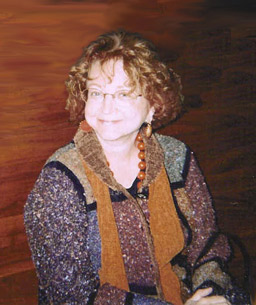
Words on a Limb Interviews Eileen Spinelli

GravatarIt was about four years ago that I brought home a book that, to this day, remains one of my children’s favourite. Baby Loves You So Much was an instant hit with my daughter, who was five years old at the time and easily related to the main character. After all, she also happened to have a baby brother whose theatrics were less than amusing. And so, for the next several months (and years), we read the book over and over – and still, over and over again (I’m not even exaggerating).

With pure admiration for Eileen Spinelli’s work and ability to engage my children with her words, I began to fill my library with more of her great stories. When I contacted her recently, she was kind enough to share her story with us.


What were you like in school – I read you started with a simple typewriter?
I was a fairly good student in school. In kindergarten I ‘composed songs’ – notes scribbled on a page which my teacher, Miss Sinclair, played on the piano. It wasn’t till a few years later I realized I hadn’t really written music. I was six when I fell in love with words and books and decided to become a writer. My father gave me his old manual typewriter and I taught myself two-fingered typing. It’s still how I type. Just faster. The first thing I remember writing was a poem about a sailboat. In High School I won a poetry prize. I used the money to buy a new typewriter and a pair of red high heels.

What is your favourite character from your books? Why?
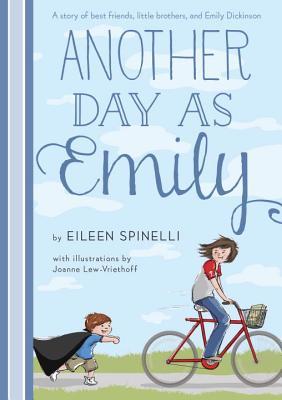
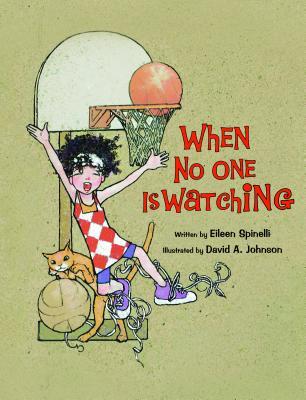
It’s difficult to choose one favorite character. A few favorites: Sophie from Sophie’s Masterpiece because she has a good heart and wants to make her world a sweeter place. Grace, the homeless woman in The Dancing Pancake because she is kind and brave. Parker in Another Day As Emily because he makes me laugh. And the narrator of When No One Is Watching because she’s shy and so am I.

Do you write an outline before you begin writing or do you let it come to you?
Sometimes I write an outline midway through a book. I seldom start with an outline.

What is the least amount of time it has taken you to complete a book? Longest?
I wrote When Mama Comes Home Tonight, a picture book, in a couple hours – revisions took longer. The novels I’ve done generally took about a year.

Who do you partner with during the editing phase?
My husband, Jerry, and I share each other’s work as we go along. We think of each other as “first editor”.

How important do you feel the book cover is for children’s picture books?
I think book covers–for children as well as adults—are quite important. I have often picked up a book because of its cover.

How do you typically market your books?
I try to keep my best energy for the writing, rather than the marketing process. But when I do approach marketing I try to give a very personal touch. An example: for my book Tea Party Today I mailed personal notes to teashops across the country as well as to tea magazines etc.

Which of your marketing strategies do you find had the most immediate impact?
I don’t keep track of which marketing strategies make the most impact. Very often interesting things happen which I’ve had no part in (except to write the book) My book Do You Have A Hat was featured in boxes of Cheerios. Friends asked how I managed that. It all happily happened without me.

Who do you picture as your reader when you write?
When I’m writing I think more of the story than of a reader. It’s only when I finish a piece I think: who would be interested in reading this.

How do you use book reviews, if at all?
I don’t know that I use book reviews. I think the publisher is more apt to use them. But it’s lovely to get a good review, something to celebrate, with a cupcake or a cookie.

Why do you think well-written books sometimes just don’t sell?
There is an element of luck, serendipity, to getting a book published. Many wonderful stories don’t sell. I would encourage unpublished writers to keep at it. That gentle bit of luck could be just around the corner.

Do you do book signings, tell us about a funny story?
Yes, I do book signings when I can. But I have to balance those with family, housework, yard work and of course my writing. So I can’t accept every invitation. A funny story: I was at a conference with a dear friend Paula Danziger. The conference was winding down and she and I didn’t have anyone at our signing table, so Paula pulled out sparkly purple nail polish and proceeded to give me a manicure.

How did you and Jerry meet?
Jerry and I met when we both worked for Chilton Publishing Company. We worked for the same magazine: Department Store Economist. He was an editor there. I was a file clerk who wrote poetry in her spare time and dumped the poems in his lap.

What do you enjoy to do on weekends beside writing?
I love ordinary days – writing in the morning, puttering in my herb garden, reading on the side porch, baking cookies, watching old movies, hanging out with the grandkids and beating Jerry at Scrabble.

What is your favourite film/book?
I have lots of favorite movies. I’m a big movie buff. One of my favorite recent films: Argo. An old film I can watch over and over: Meet Me in St. Louis.

My favorite author as a kid was Marguerite de Angeli. A neighbor gave me her beautiful book: Thee, Hannah! for my 12th birthday. It was a treasure then…and now. I still have it. I had the privilege of meeting Ms. de Angeli years ago. She signed that copy for me over lunch.

What advice would you give your younger self?
Advice to my younger self: Allow more of life to unfold. Someone wiser than I put it this way: “Don’t push the river.”

Tell us about your most recent work.
My most recent book: Another Day As Emily. I’ve always loved Emily Dickinson and looked for a way to fold her into a book. Besides writing books I write for Highlights Magazine and their other two publications: High Five and Hello.
Great fun!


You can read more about Eileen:

 email-icon-png-blue-9vzn7mz2 amazon Goodreads wordpress-logo-circle 


Another Day as Emily
by Eileen Spinelli
Knopf Books for Young Readers
Amazon | Chapters | Barnes & Nobel

“Taut, fast-paced, economical, devoid of sham, Spinelli’s book echoes Dickinson’s own deceptive simplicity.”—The New York Times Book Review

Eleven-year-old Suzy just can’t win. Her brother is a local hero for calling 911 after seeing their elderly neighbor collapse, and only her best friend was able to win a role in the play they both auditioned for. Feeling cast aside from all angles, Suzy sees a kindred spirit in Emily Dickinson, the subject of her summer project. Suzy decides to escape from her disappointments by emulating the poet’s life of solitude: no visitors or phone calls (only letters delivered through her window), no friends (except her goldfish, Ottilie), and no outings (except church, but only if she can wear her long white Emily dress).

But being a recluse is harder than Suzy predicted. Will she find a way to fold Emily into her life while also remaining true to herself?


Eileen has been an amazingly prolific author with 97 works. We feel privileged to have spent a moment with her. Take a look at a small sample of her vast body of work (books below published since 2010)


Inspirational video about Eileen and Jerry’s special connection with writing:


Untitled-1Words on a Limb would like to extend a warm hug to Eileen. In my conversations with this accomplished author, I’ve felt nothing but kindness and genuine affability. It was a pleasure connecting with her. Eileen Spinelli’s stories have spread over 30 years in books, magazines, publications and anywhere a child is willing to hear a wonderful story. Our family will be enjoying your work for years to come.

We wish you continued success, Eileen and Jerry; your careers are an inspiration!

Lora

Words on a Limb Interviews Trilby Plants

I met Trilby Plants on our Facebook Page. We connected and spoke about how important it was to support each other in the writing community. I read up on Trilby and found that she has led a fascinating life.

She shares that she was immediately hooked on words when, at the age of four, her mother read her Gulliver’s Travels. There began her love of all things speculative and fantastical. All her life she’s been telling stories about fairies and creatures – real and imagined – and things that go bump in the night. Trilby is currently editor of The Petigru Review, the yearly literary anthology of the South Carolina Writers’ Workshop. She lives with her sports junkie husband in Murrells Inlet, SC, where she writes, knits and plays golf.

Trilby took some time away from golf clubs and knitting needles to sit under our Author’s Spotlight. Among other great information, she shares some great tips for beginning writers. Take a look!


About writing …

When did you first realize you wanted to become a writer?
When I was in fourth and fifth grade grades, I lived in a tiny town in eastern Montana. My teacher, who was ahead of her time, had us writing and illustrating little books. She sent one of my drawings and a book I wrote to the Montana State Fair. I won blue ribbons on both. I was hooked on stories.

Both my parents were avid readers, so books and magazines were plentiful around our house.

Then life intervened – growing up, college, marriage, career and children. Along the way I dabbled in poetry, nonfiction, short fiction and the inevitable first novel, which remains in a box under my bed. As a teacher I channeled my love of story-telling by encouraging writing. My first children’s book, Hubert Little’s Great Adventure, came from a decades old story I wrote along with my students when I first began my teaching career. I scanned the old illustrations, Photoshopped them into parts, used some digital backgrounds and put the book together. It was purely a labor of love for my then three-year-old granddaughter. Hubert will have more adventures. Now that my granddaughter is reading everything she can get her hands on, the next Hubert story might be a chapter book.

What book(s) has most influenced your writing?
My mother read to me and my brother when we were young. The first I remember was Gulliver’s Travels when I was four. I loved Swift’s complex language and the imagined journeys to faraway lands where Gulliver met fantastical beings. By brother, a year younger, only remembers the scene where Gulliver urinates on the town to save it from a fire.

I am a voracious reader. I loved Ray Bradbury’s stories. His blend of the ordinary with the fantastic appealed to me, as did his somewhat literary style.

When and where do you prefer to write?
I find myself most productive during the day, usually after lunch. I’ve never been much of a morning person, so I use mornings to ponder ideas and afternoons to bring them to life. My desk is in our guest room and looks out at a berm of trees. Squirrels’ entertaining antics force me to look away from the computer every once in a while.
Continue reading

Back-to-School Favourites

GravatarHere it is – a collection of my favourite Back-to-School literature. Some are new, others are older classics. Please feel free to share your discovered gems in the Reply box below. I will continue to update this list, so please come back and check again (because we can never have too many).


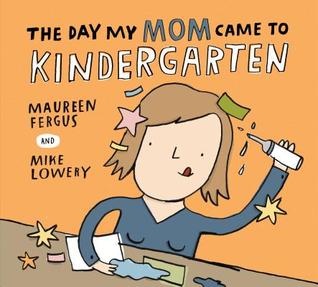
The Day My Mom Came to Kindergarten
Maureen Fergus
Kids Can Press

A kindergartener invites her mom to class and discovers there are some things kids are better at than parents. This book makes a perfect gift for readers who are about to start or have recently started school.


Llama Llama Misses Mama (Llama Llama)
Anna Dewdney
Viking Juvenile

Strange new teacher.
Strange new toys.
Lots of kids and lots of noise!

What would Llama like to do?

Llama Llama feels so new . . .

It’s Llama Llama’s first day of preschool! And Llama Llama’s mama makes sure he’s ready. They meet the teachers. See the other children. Look at all the books and games. But then it’s time for Mama to leave. And suddenly Llama Llama isn’t so excited anymore. Will Mama Llama come back?

Of course she will. But before she does, the other children show Llama Llama how much fun school can be!

Continue reading

Who Took the Cookies from the Cookie Jar???

handJar

Shhh, don’t tell them, but it was me!

Here is a fun and tasty idea for the first week back to school …


Print and cut-out enough cookiecookiesLyrics templates so that each student has one with their name written on the back (you may want to invite students who are able to write their name independently, to do so prior to beginning). Place all the cookies in a jar and with all the students sitting in a circle, introduce the song, Who Took the Cookies from the Cookie Jar.  While singing, pull out one cookie at a time and hold it up for the class to read. You may want to help by encouraging students to look at the letters for clues. For example, “This person’s name begins with the letter B, which makes a bbb sound.  I wonder whose name this could be?” If you like having your students wear name tags during the first few weeks of school, you may want to invite them to take off their tags at this point and look closely at the letters in their name. Throughout the day, continue to pull out more cookies from the jar until each child’s name has been called (if you have a small class, one sitting may do).

cookiesWritingYou might also want to revisit this activity with a small group of students or else with a different focus in mind (i.e., sorting: girls and boys, long names and short names; counting: number of letters in each name, number of students; graphing: organizing the information, etc.).  I like to repeat this activity several times during the first couple of weeks of school. Students are quite amused by it and it is a great way to learn each other’s names while learning important skills at the same time. As an extension, I prepared a follow-up writing piece where students are invited to write their name and draw a picture of themselves eating cookies (a great time for an art lesson).  While some students may be able to write their name independently, others may need to copy or trace the letters from their name tag (tracing over a highlighted name works well too).

cookieTemplatesThe jar can then be put to further use by placing it somewhere in the room for students to access during Centre/Play time. Depending on the various skills you introduced with the activity, students may want to explore some of them independently or in a small group (i.e., counting, sorting, etc.).

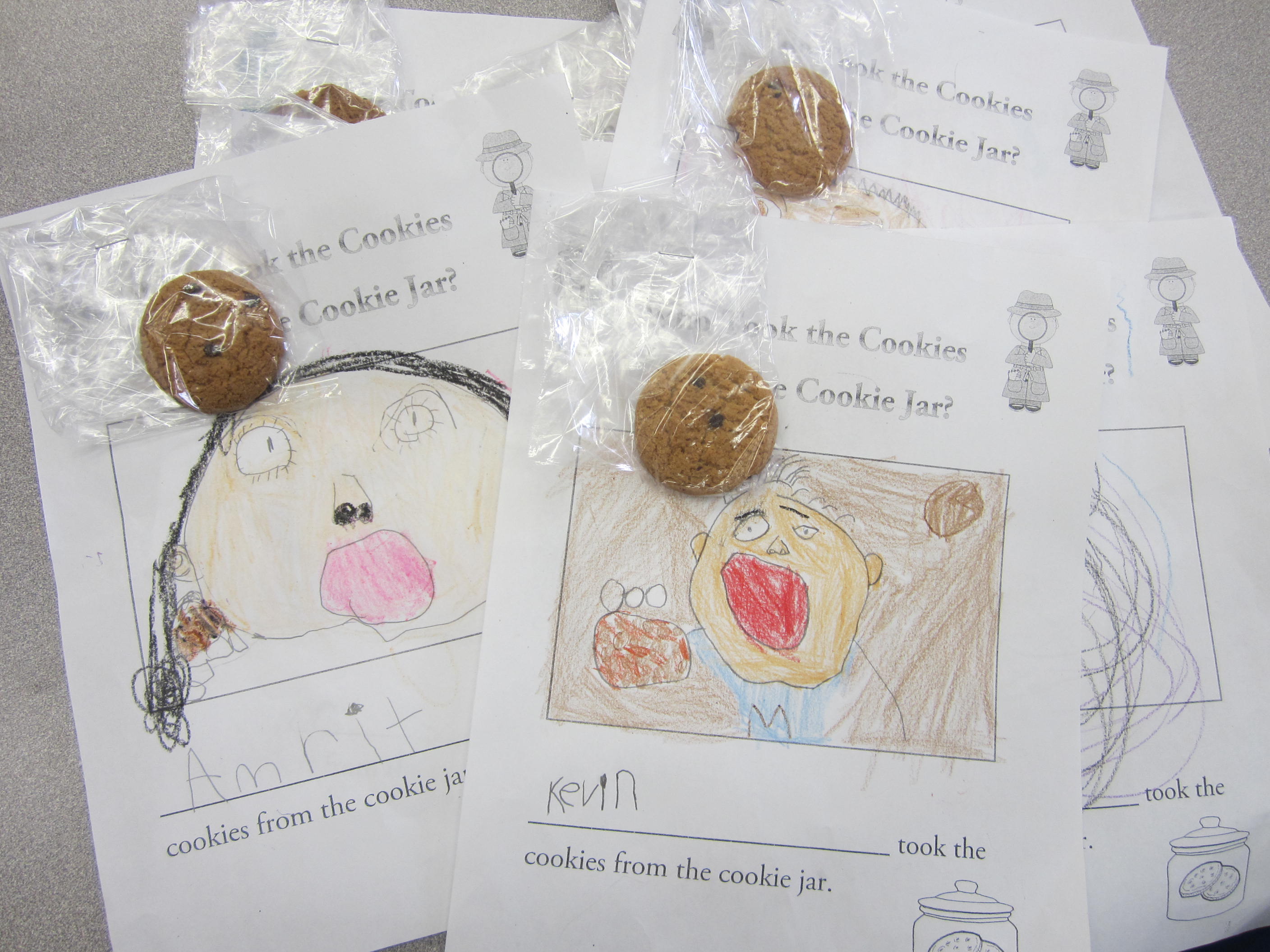
** To download a copy of the song, cookie templates and follow-up writing activity, press on the cookie jar below.

Please take a moment & let us know if you enjoy this Free Teacher Content by pressing  Like button or visiting us on our Facebook Page.

sketchCookie

Thank you and have a sweet and fabulous start to the school year.

IMG_3779

Lora

Please Stay Awhile

peekingGirl

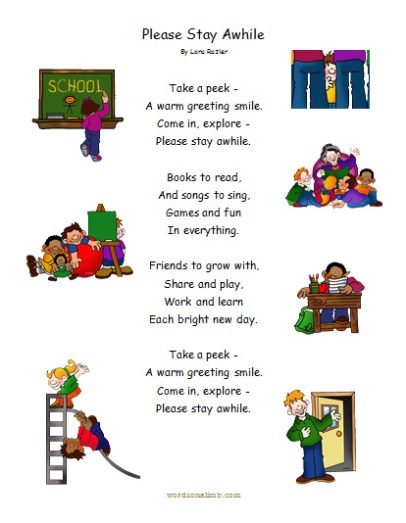
Hello everyone.  Hard to believe, but the summer months are drawing to a close.  September is right around the corner and a new school year is about to commence.  For us, teachers, it is that time again – setting up, organizing, preparing and planning for the year ahead.  As we get ready to open our doors and our hearts to the newest treasures, I would like to share a poem I wrote, welcoming everyone on this great journey together.  Feel free to download a copy of the poem and use it in your classroom – just click on the image below.

PleaseStayAwhile!

One of the things I like to set up at this time of year is individual student portfolios.  I designate a specific area in the classroom for showcasing each child’s work in a bulletin format.  Throughout the year I make sure to add new writing pieces to each child’s portfolio, highlighting their growth and changes over the course of the year.  It is always fascinating to see their progress, however big or small their steps may be.

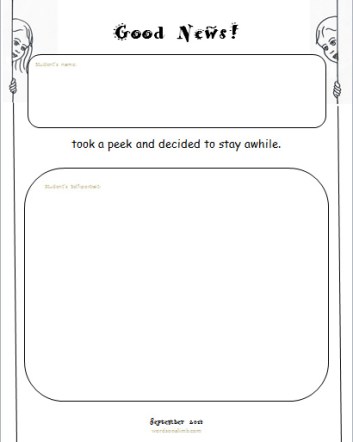
boyPeekingAs an extension to the poem, Please Stay Awhile, I prepared an initial portfolio assignment.  Toward the end of the first week of school, students will be invited (in small groups) to sketch a picture of themselves and write their name.  Please note that this is not an assessment piece.  It merely gives me an indication of where my students are at – a point of reference for each child’s starting point.  It is also a great way for me to see what my returning SK students retained from the previous year.  Perhaps the best use of this task is that it allows me to plan my program in a way to address whole-group as well as individual needs.  Feel free to download a copy of the template by clicking on the image below.
GoodNews

Happy Start-of-the-Year everyone.  As always, your comments and feedback are most welcome.

If you enjoy the Free Teacher Content, please let us know by pressing  Like button
or visiting us on our Facebook Page.

Thank you,

Lora


Creative Commons License
Please Stay Awhile by Lora Rozler is licensed under a Creative Commons Attribution-NonCommercial-NoDerivatives 4.0 International License.

You are Enough – You Matter!

08a37230a6bf842869d68b5ccc2ead17  It’s For You

Originally posted on

I was thirteen when someone very close and dear to me was ready to give up – ready to leave behind their whole life and not wake for another day. Here we are seven years later and I remember this day vividly, like it was yesterday. It was a traumatizing and painful experience but what pains me today the most is my reaction to it. My anger and disgust towards her. How could she possibly be so selfish to leave just like that? How could she be so stupid to think that this would solve everything? How could she do this to me and everyone that loves her? Why would she even do this? Nothing made sense. Nothing.

I wish I could say that when by some miracle she made it because she was found and brought in on time, that I felt joy and relief. That my heart was filled with love and happiness and that all anger was gone. I wish I could say that I understood. I wish I could say that I ran up to her with open arms and a smile, held her hand and told her it was all going to be ok – that she had my love and support unconditionally. I wish I could say that why she did what she did made even a little bit of sense to me. But I can’t say any of that.

Most of all, I wish I could say I knew it was depression and I understood that she was sick and I could not blame her for this. But when you’re thirteen, the ignorance of your teenage years doesn’t always allow you to think about others. And all I thought about was how could she have put me through that. For years I was upset. Years. And then one day I turned around and became an advocate for mental health. Because finally, I understood.

So to all those suffering from a mental illness, this is for you.

Continue reading