
 I met Trilby Plants on our Facebook Page. We connected and spoke about how important it was to support each other in the writing community. I read up on Trilby and found that she has led a fascinating life.
She shares that she was immediately hooked on words when, at the age of four, her mother read her Gulliver’s Travels. There began her love of all things speculative and fantastical. All her life she’s been telling stories about fairies and creatures – real and imagined – and things that go bump in the night. Trilby is currently editor of The Petigru Review, the yearly literary anthology of the South Carolina Writers’ Workshop. She lives with her sports junkie husband in Murrells Inlet, SC, where she writes, knits and plays golf.
Trilby took some time away from golf clubs and knitting needles to sit under our Author’s Spotlight. Among other great information, she shares some great tips for beginning writers. Take a look!
About writing …
When did you first realize you wanted to become a writer?
When I was in fourth and fifth grade grades, I lived in a tiny town in eastern Montana. My teacher, who was ahead of her time, had us writing and illustrating little books. She sent one of my drawings and a book I wrote to the Montana State Fair. I won blue ribbons on both. I was hooked on stories.
Both my parents were avid readers, so books and magazines were plentiful around our house.
Then life intervened – growing up, college, marriage, career and children. Along the way I dabbled in poetry, nonfiction, short fiction and the inevitable first novel, which remains in a box under my bed. As a teacher I channeled my love of story-telling by encouraging writing. My first children’s book, Hubert Little’s Great Adventure, came from a decades old story I wrote along with my students when I first began my teaching career. I scanned the old illustrations, Photoshopped them into parts, used some digital backgrounds and put the book together. It was purely a labor of love for my then three-year-old granddaughter. Hubert will have more adventures. Now that my granddaughter is reading everything she can get her hands on, the next Hubert story might be a chapter book.
What book(s) has most influenced your writing?
My mother read to me and my brother when we were young. The first I remember was Gulliver’s Travels when I was four. I loved Swift’s complex language and the imagined journeys to faraway lands where Gulliver met fantastical beings. By brother, a year younger, only remembers the scene where Gulliver urinates on the town to save it from a fire.
I am a voracious reader. I loved Ray Bradbury’s stories. His blend of the ordinary with the fantastic appealed to me, as did his somewhat literary style.
When and where do you prefer to write?
I find myself most productive during the day, usually after lunch. I’ve never been much of a morning person, so I use mornings to ponder ideas and afternoons to bring them to life. My desk is in our guest room and looks out at a berm of trees. Squirrels’ entertaining antics force me to look away from the computer every once in a while.
Continue reading




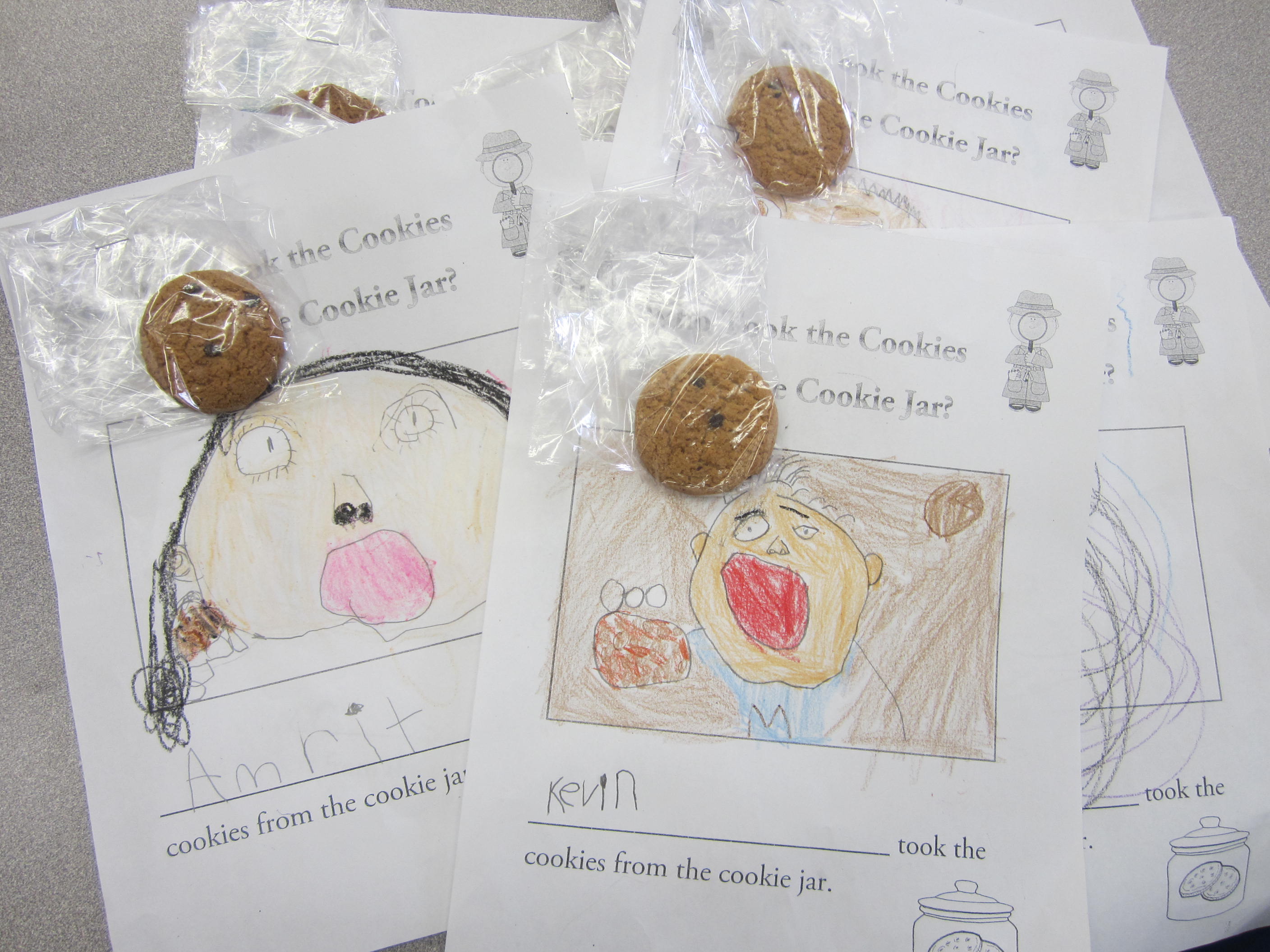
 templates so that each student has one with their name written on the back (you may want to invite students who are able to write their name independently, to do so prior to beginning). Place all the cookies in a jar and with all the students sitting in a circle, introduce the song,
 The jar can then be put to further use by placing it somewhere in the room for students to access during Centre/Play time. Depending on the various skills you introduced with the activity, students may want to explore some of them independently or in a small group (i.e., counting, sorting, etc.).


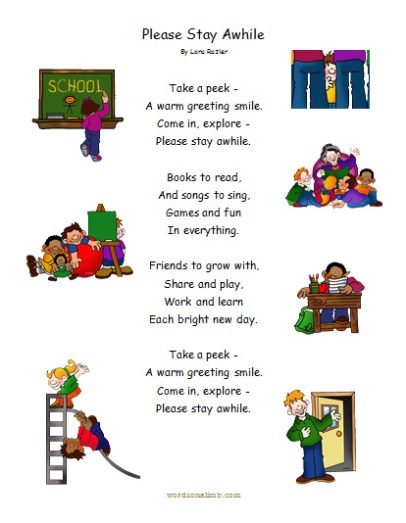
 As an extension to the poem, Please Stay Awhile, I prepared an initial portfolio assignment. Toward the end of the first week of school, students will be invited (in small groups) to sketch a picture of themselves and write their name. Please note that this is not an assessment piece. It merely gives me an indication of where my students are at – a point of reference for each child’s starting point. It is also a great way for me to see what my returning SK students retained from the previous year. Perhaps the best use of this task is that it allows me to plan my program in a way to address whole-group as well as individual needs. Feel free to download a copy of the template by clicking on the image below.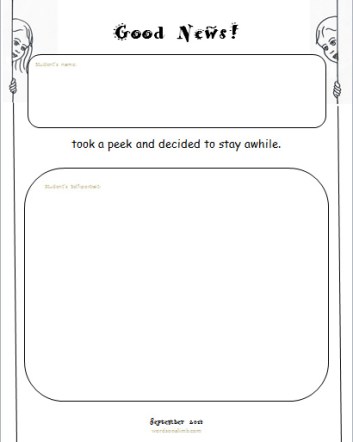



 Words On A Limb